Guide to Careers in 2030

France and Europe — evidence, twenty occupational profiles and practical pathways. Edition 1.0 · 4 October 2026.

Original illustrations depict imagined situations, not interviewed practitioners. The diagrams explain concepts; all substantive guidance is also available in the text.
Contents
How to use this guide
Choose a career by investigating work you could actually do, in a place where you could live, through an entry route you can afford. This guide helps you make that investigation. It brings together labour-market evidence, twenty occupational profiles, alternative futures and a practical method for testing a decision before making a large commitment.
The geographical focus is France, with a European perspective. The guide is written in English; French qualification names are retained so that you can find the correct official programme. Training routes, professional requirements and public support described as French apply to France. They are not a licence to practise elsewhere. If you are planning a move, check professional recognition, language requirements, residence and employment rules with the destination’s competent authorities.
Start with the evidence chapter if you want to understand a claim about future jobs. Start with the occupational profiles if you already have a shortlist. Use the 90-day investigation and worksheets when you need a concrete next step. Return to the scenarios before taking on substantial costs or a qualification lasting several years.
The twenty profiles are a deliberately varied selection of work situations. They include caring, technical, digital and organisational work, and several vocational routes. They are not a ranking of the twenty fastest-growing occupations. Selection reflects usefulness for exploring different forms of work, availability of official entry information and relevance to the guide’s themes. It does not establish that an occupation is hiring near you.
Research cut-off: 4 October 2026. Edition: 1.0. Editorial project: The Rebel Marketer, commissioned by Jacques-Louis Kreiss. This is a new TRM guide, distinct from France Stratégie and Dares’ official report Les métiers en 2030.
Read the evidence label
An observation describes a measured situation, with a place and a period. A projection extends a model under stated assumptions. A scenario explores a plausible future conditional on particular developments. An editorial method is a proposed way to investigate your choice. These four kinds of statement serve different purposes.
References in square brackets point to the source directory. Original illustrations show imagined situations; they are not photographs of interviewed practitioners. The task analysis and exercises in each profile are TRM editorial suggestions, not measured AI impacts for that profession.
Understanding French study labels
The baccalauréat is France’s upper-secondary qualification. “Bac + 3” and “bac + 5” describe study levels three and five years after it; they are not a licence to practise. CAP refers to a vocational qualification, BTS to the brevet de technicien supérieur, and BUT to the bachelor universitaire de technologie. A diplôme d’État is a state diploma. Keep the exact French award name when searching, and verify admission, recognition and professional requirements separately. The profiles give specific official sources for each route.
Research and reviews were assisted by specialised AI agents, including a scientific research role, orientation research, practical and integrity reviews, and the Oracle strategic foresight role. No human expert interviews or professional endorsements are implied. Their disagreements and the resulting corrections are recorded in the production dossier. A qualified practitioner’s feedback on your own work remains an essential part of the method.
A quick route through the guide
1. Write down your non-negotiable constraints: income, time, travel, health, care responsibilities and training capacity.
2. Choose two profiles that describe activities you would like to investigate. Include a neighbouring option with a different entry route.
3. Collect current local evidence and ask what beginners actually do. Check the date, contract and working conditions behind an attractive job title.
4. Try a safe, limited exercise and obtain feedback. Record what you can do and what you still need to learn.
5. Compare routes and costs, then choose the next commitment you can justify. Revisit the decision when circumstances or evidence change.
What to watch before 2030
Retirement, care needs, infrastructure, environmental adaptation and digital tools all matter. Their effect on an individual career depends on employers, budgets, geography and access to training. A socially necessary service can remain understaffed and difficult to work in. A growing sector can have few suitable junior positions. An impressive demonstration can fail when deployed in a real workflow.
Treat a shortage as a reason to ask questions. Why is hiring difficult? Is the work seasonal? Are shifts fragmented? Is there safe supervision? Are departures frequent? Can a new entrant learn without being expected to carry responsibilities they are not qualified for? These answers often matter more than a national growth figure.
This guide avoids future salary promises. To assess pay, compare current local offers on equivalent terms and include unpaid travel, on-call duties, contract duration and costs. A career decision needs a viable household plan, not only a headline annual salary.
Making room for your circumstances
A path should fit your circumstances rather than require you to ignore them. If mobility is limited, investigate employers within a realistic commuting area before choosing a specialist course. If caring responsibilities limit your schedule, ask about actual shifts and flexibility. If you need workplace adjustments, focus the enquiry on tasks and arrangements; you do not need to disclose private medical details in a portfolio.
Experience from earlier work can be valuable even when a qualification is still necessary. Describe achievements in terms of actions and results, and ask which skills transfer. For a first job, look for supervised learning and assess what the employer entrusts to beginners. For a long qualification, compare both the destination and the years required to get there.
Do not assume that self-employment solves a weak local employment market. It adds the need to find customers, price work, cover downtime, comply with applicable requirements and fund equipment. Test demand and total costs before presenting it as your fallback. These considerations are editorial decision guidance, not a forecast of business success.
What the labour-market evidence actually says
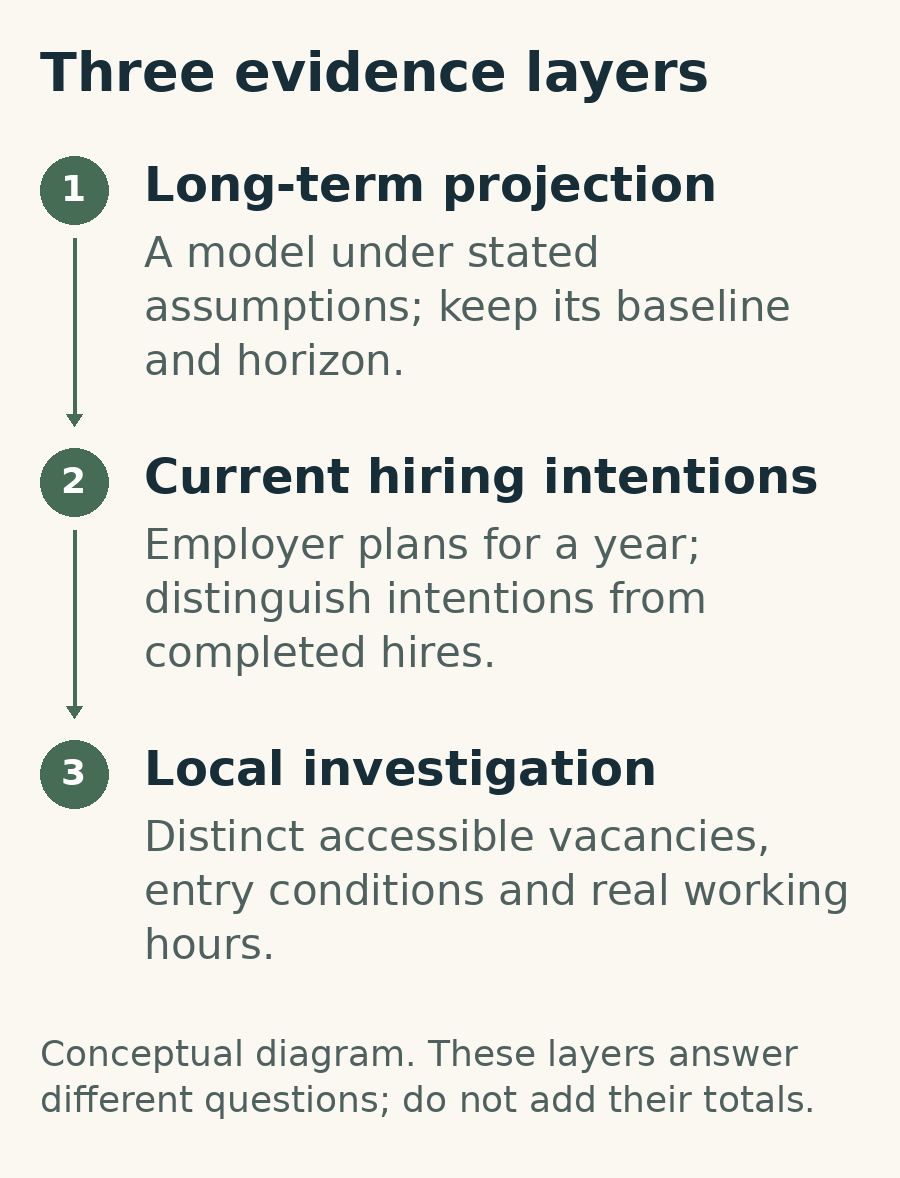
Original conceptual diagram. Three evidence layers: long-term projection, current hiring intentions and local investigation. These answer different questions; do not add their totals.
France’s long-term projection, current employer intentions and Europe’s harmonised forecast answer different questions. They can inform your investigation, but should not be combined into a single total of “future jobs”.
France has a useful but dated 2030 baseline
France Stratégie and Dares’ 2022 reference scenario projected an average of 760,000 openings a year over 2019–2030 in metropolitan France. Roughly nine in ten came from end-of-career departures, rather than additional employment. The same exercise projected one million net additional jobs over the whole period. These are conditional estimates, not vacancies still available in October 2026. [EMP01, EMP02]
The macroeconomic assumptions were fixed in November 2021. That makes the exercise valuable as a structural baseline, while limiting its use as a current forecast after subsequent shocks and widespread generative AI adoption. The regional extension also shows that opportunities differ between territories. Consult it alongside current local evidence. [EMP02, EMP07]
Current recruitment can move against a long-term narrative
France Travail’s BMO survey, published on 21 April 2026, records approximately 2.3 million employer hiring projects, down 6.5% from 2025. Employers considered 43.8% difficult, 6.3 percentage points lower than in the previous survey. Construction intentions fell 16.4%. These are intentions, including replacements and seasonal work, rather than completed hires or a census of vacancies. [EMP04]
The fall in construction is a useful counter-signal: an environmental need or renovation objective does not establish a growing pipeline of funded jobs this year. Ask which projects are contracted, which skills employers need and whether beginners are being recruited.
Europe’s latest forecast runs to 2035
Cedefop’s update of 21 July 2026 projects more than 4% cumulative EU-27 employment growth between 2023 and 2035. Broad ICT professional and technician occupations have projected annual growth of 2.5%; health and care occupations almost 1%. The release also strengthens replacement-demand analysis and distinguishes vocational from general intermediate qualifications. These are conditional European aggregates through 2035, not French junior recruitment rates or 2030 guarantees. [EMP06]
Five questions to ask about a number
What is the territory? What period does it cover? Does it count workers, new jobs, replacement needs, hiring intentions or advertisements? What assumptions or method produced it? What does it tell you about a position accessible at your experience level?
For a local decision, keep a dated set of distinct vacancies and supplement it with conversations. Record requirements, contract type and conditions. If you find only a few offers, report that fact rather than interpreting a national trend as local demand. Vacancy collection is an investigation tool; it is not a representative statistical survey.
Terms that change the interpretation
Net employment change is the difference in employment between two points. Hiring and job loss can both be substantial beneath that net figure.
Projected openings in the French exercise combine employment change and end-of-career departures. They do not count every short-term replacement hire.
Hiring intentions are employers’ stated plans. Some will not be realised, and they may cover different forms and lengths of employment.
Recruitment difficulty describes the relevant employer or statistical indicator. It may reflect qualifications, location, pay, schedules or other conditions.
AI exposure describes tasks that may be affected by a technology. Adoption, useful performance and employment consequences require separate evidence.
AI changes tasks before it settles careers

Original conceptual diagram. Four separate questions about AI: technical exposure, actual adoption, task outcomes and employment effects. Every transition needs evidence.
The main finding
AI can speed up certain tasks, worsen other outcomes and change entry-level recruitment without immediately eliminating an entire occupation. The useful career questions are: which tasks change, who retains responsibility, and how can a newcomer acquire the experience employers require? Saying a job is exposed to AI answers none of these questions.
A job combines tasks, relationships, physical constraints, responsibility and a business model. An assistant can draft a letter without conducting a difficult negotiation, produce a report without delivering care, or suggest code without being responsible for deployment. This does not make those occupations immune. Employers might reduce staffing, serve more customers, develop a new service or redistribute work. Outcomes depend on demand, prices, organisation and quality obligations. This is an editorial interpretation of the evidence, not a quantified forecast.
Findings and their limits
1. Exposure is technical potential, not a count of redundancies. The ILO–NASK index published on 20 May 2025 places one in four workers worldwide in an occupation with some exposure to generative AI. The highest exposure category represents 3.3% of global employment. Across all exposure categories, the share reaches 34% in high-income countries. The index combines task descriptions, survey responses, expert input and model assessments. Clerical occupations are particularly exposed. Its finding concerns potential changes in work; it does not mean that one quarter of jobs will disappear. [IA01]
2. Customer support shows a substantial, context-specific productivity gain. Brynjolfsson, Li and Raymond's article, published in the Quarterly Journal of Economics in 2025, examines a staggered rollout involving 5,172 agents. Issues resolved per hour increase by 15% on average. Less experienced agents benefit more than the strongest agents. The system can help disseminate useful practices, but the result belongs to one organisation and workflow. It does not predict future recruitment or a 15% pay increase. Use the final publication's 15%, rather than repeating the 14% from an earlier version. [IA02]
3. Professional writing experiments demonstrate task-level effectiveness. Noy and Zhang randomly allocated access to ChatGPT among 453 college-educated professionals completing incentivised writing exercises. Average completion time fell by 40% and assessed quality increased by 18%. Published in Science in 2023, these are causal results for the tested exercises. They do not automatically extend to work requiring original investigation, independent sources, legal validation or tacit knowledge. Faster production says nothing by itself about future sales or how many people an employer will need. [IA03]
4. Software development provides an important counterexample. In METR's randomised study, 16 experienced developers completed 246 real tasks in projects they knew well. Allowing early-2025 AI tools increased completion time by 19%. Participants nevertheless believed the tools had made them faster. The study demonstrates why perceived improvement needs checking against measured results. Its sample is small and specialised, and the tools were those available between February and June 2025. It does not establish that AI slows every developer or that 2026 tools have the same effect. METR's February 2026 follow-up suggests speedups may now be more likely, but recruitment, task-selection and measurement problems make its new estimates unreliable. The original finding remains evidence about the early-2025 setting, not a description of current tool performance. [IA04, IA09]
5. Saving individual time does not necessarily reorganise work. Dillon and colleagues' field experiment covers 66 firms and 7,137 workers. In the second half of the six-month experiment, users among workers assigned access spent two fewer hours per week on email. The authors did not detect changes in task quantity or composition from individual access alone. The denominator matters: users were 80% of the treated group, so the two-hour result should not be attributed indiscriminately to every employee. Time saved on email is not evidence of wage growth or additional jobs. [IA05]
6. Danish work changes before conventional labour statistics move. Humlum and Vestergaard's working paper, revised on 13 March 2026, links surveys to administrative records in 11 exposed occupations. The latest survey covers 25,000 workers and 7,000 workplaces. Two years after ChatGPT's launch, the study detects no effects on earnings or recorded hours and rules out effects larger than 2% within its framework. Meanwhile, workplaces create integration and oversight tasks. Its current title is Still Waters, Rapid Currents. Using only its previous title would miss the revised emphasis on work reorganisation. A short-term null result cannot establish the absence of future effects. [IA06]
7. Entry-level hiring shows a serious US warning signal, explicitly non-causal. Stanford's revision of 12 August 2026 uses ADP payroll data through June 2026. Employment among 22–25-year-olds in highly exposed occupations is about 19% below the level it would have reached if it had kept pace with their less-exposed peers. Adjustment appears to operate mainly through hiring rather than separations. The authors report no widespread economy-wide displacement and describe the findings as descriptive, not causal. Education controls, prior trends and sample representativeness limit interpretation. This is neither “19% of young people fired by AI” nor a French statistic. [IA07]
8. Across Europe, technical capability does not determine adoption. Golo Henseke's preprint, revised on 28 April 2026, analyses 35 European countries using the 2024 European Working Conditions Survey. Adoption ranges from under 3% to 25% across countries. Skills, task content, employees' influence in organisations and training accompany diffusion. The analysis detects no effect on workers' reported task restructuring at that stage. Date the evidence correctly: the paper appeared in 2026, but observations concern 2024. The current version is titled From Exposure to Adoption: Generative AI in European Workplaces. [IA08]
Why apparently conflicting findings can coexist
An experiment can identify a causal effect on a particular task while administrative records show broadly stable earnings. Employers may allocate saved time to other duties; contracts, salaries and markets can adjust more slowly. Conversely, junior recruitment can weaken in some segments without reducing total employment.
The Danish and American studies differ in country, timing, populations and methods. They cannot settle a binary argument over whether AI creates or destroys jobs. Randomised experiments provide strong evidence for the tested setting; extending them requires more evidence. Administrative records describe real employment, but identifying AI's separate contribution remains difficult. Exposure indices map technical possibilities without measuring their adoption.
None of these eight findings is a reliable numerical forecast of French employment in 2030. Keep the Oracle's scenarios separate from observed results. Do not invent numerical career safety ratings. Do not present different studies as independent confirmation of the same exact forecast when they measure different outcomes.
A practical method for readers
Start by breaking a target occupation into five activities: standard production, verification, a consequential decision, a difficult interaction, and any physical intervention. For each, describe what an assistant might prepare, which mistakes are costly and who is authorised to approve the result. This creates a map of work rather than an anxiety-inducing ranking.
Next, run a short test on public or fictional data. Complete the same kind of task with and without assistance. Define a quality rubric before testing. Measure total time, correction time and outcome quality; have someone review the result. Record suggestions you rejected and explain why. A polished output does not establish competence if you cannot recognise its mistakes.
For an entry-level position, look for supervised practice through an apprenticeship, properly supervised placement, authorised work observation or a useful project with a voluntary organisation. The aim is to learn exceptions, constraints and professional judgement. This is not a recommendation to provide unpaid labour to a commercial employer. In regulated or dangerous occupations, a personal project never replaces qualifications, supervision or authorisation.
Build a portfolio that demonstrates mastery: the problem, your personal contribution, tools used, checks, limitations and outcome. “I know ten tools” gives less useful information than “I solved this problem, detected these errors and respected these constraints.” Durable preparation combines a concrete domain, measured tool use and the ability to work with others. Do not recommend a standalone “prompt engineer” role as a guaranteed career route without evidence of local demand and realistic entry requirements.
Before paying for training, examine accessible vacancies in your employment area and speak with practitioners. Look for repeated requirements: qualifications, experience, shifts, language, mobility and specific tools. Separate essential requirements from preferences. Revisit this evidence regularly. A highly visible job title may have very few openings; national statistics may conceal a lack of opportunities near home.
When interviewing, ask who checks AI-assisted work, what training junior staff receive and which responsibilities remain human. Ask how errors are investigated and how productivity gains are used. The answers reveal the quality of the learning environment. An employer expecting a beginner to validate specialist outputs without supervision creates a poor entry route, however fashionable the tool.
Three possible futures for 2030
Separate evidence, inference and scenarios
Published evidence. Cedefop updated its skills projections on 21 July 2026: they cover 2023–2035 and distinguish replacement needs and vocational versus general intermediate qualifications [OR01]. Eurostat reports AI technology use in 20.0% of covered enterprises with at least 10 persons in 2025, compared with 13.5% in 2024; its survey does not cover every employer. The 2025 questionnaire added image, video and audio generation, so comparisons also need to account for this change in coverage [OR02]. The IEA identifies shortages of applied technical skills and workforce replacement as energy-sector constraints worldwide [OR03]. The European Commission documents ageing through 2022–2070 projections [OR04]. France launched its third National Climate Change Adaptation Plan in March 2025, with 52 measures [OR05]. The EIB's March 2026 investment report examines European investment resilience and its constraints [OR06].
The guide's inferences. A persistent social need does not automatically create funded vacancies. Employers can adopt AI while maintaining headcount, changing their recruitment mix or reducing some roles: adoption statistics do not establish which outcome occurs. Retirement can generate openings even in a shrinking occupation. Skills transferable between maintenance, renovation and operations can provide more options than a specialism dependent on one temporary programme.
Editorial scenarios. We vary two drivers: the extent to which AI changes real organisational processes, and the capacity to fund and execute investment in infrastructure and people. Ageing and climate adaptation cut across all three scenarios. The scenarios are not exhaustive and can coexist across sectors and regions.
Scenario A — Investment turns into implementation
Conditional 2030 picture. Investment becomes delivered projects: grids, building renovation, water, climate adaptation, healthcare and training. AI assists selected tasks while increasing the need to organise data, controls and accountability.
Critical assumptions. Funding is secured; infrastructure keeps pace; employers train their teams; procurement schedules become dependable. Some productivity gains help meet unmet demand.
Work to investigate, without an employment promise. Electrical and industrial maintenance, water operations, renovation and summer comfort, care and support, digital integration and data quality. Value comes from delivering a reliable service, rather than including “green” or “AI” in a job title.
Supporting signals. Contracts awarded and projects completed; recurring maintenance work; recruitment and apprenticeships increasing; training providers showing verified employment outcomes; AI systems used with named responsibility.
Counter-signals. Announcements without orders; connection delays; frozen budgets; extensive training with weak placement; high turnover concealing difficult working conditions.
What does this change now? Build a recognised technical or professional foundation, then learn a practical use of digital tools. Look for an employer that can demonstrate delivered projects and available supervision. Produce evidence of quality: a diagnosis, measurement, procedure or acceptance record.
Scenario B — AI advances while entry routes narrow
Conditional 2030 picture. Employers automate more routine and document-based tasks. Some reduce entry-level hiring and concentrate responsibility in smaller teams, while field-based occupations remain constrained by costs and staffing.
Critical assumptions. Tools become reliable and integrable for the relevant workflows; margin pressure encourages some employers to reduce teams; employers invest more in software than in developing beginners. Theoretical AI exposure alone is insufficient to establish this scenario.
Work to investigate. Digital work grounded in a specific domain, quality assurance, security, data, integration and complex customer relationships; field activities combining intervention, diagnosis and accountability. This does not imply that all manual work is protected or all digital work disappears.
Supporting signals. Persistent decline in junior recruitment within comparable occupations; fewer learning tasks assigned to beginners; higher experience requirements; tools handling complete workflows rather than isolated demonstrations.
Counter-signals. Hiring resumes after unsuccessful automation; verification costs outweigh savings; demand expands; structured apprenticeship returns.
What does this change now? Avoid building a professional identity solely around producing generic text, images or code. Combine tool use with domain knowledge, a checkable result and responsibility. Ask employers how beginners learn. Demonstrate that you can verify, explain and correct work, including without AI assistance.
Scenario C — Needs grow faster than resources
Conditional 2030 picture. Organisations face ageing, climate-related disruption and ageing infrastructure, while funding and investment remain insufficient or unstable. Some prioritise maintenance, repair and service continuity.
Critical assumptions. Costs, finance, trade shocks or public spending choices delay projects; demand does not fully become funded employment. Essential services face pressure without a guaranteed improvement in working conditions.
Work to investigate. Maintenance and repair, operations and reliability, local support services, continuity logistics, procurement and quality. Necessary work can be poorly paid or demanding: “essential” does not mean well paid or easy to enter.
Supporting signals. Projects postponed; equipment replacement delayed; spending diverted to repairs; persistent vacancies alongside rapid departures; service needs rising without matching funding.
Counter-signals. Multi-year finance secured; expansion orders; verified pay improvements and better retention.
What does this change now? Make the cost and reversibility of a career change central. Where feasible, favour workplace experience, a recognised qualification and a verified local route to employment. Before entering care, support or field work, test schedules, travel and physical or emotional demands. Preserve skills usable in another sector.
Compare futures without inventing an employment ranking
What should you verify?
A: investment implemented: Orders and delivered projects
B: narrower entry routes: Junior recruitment and learning
C: constrained resources: Recurring funding and job quality
Where could your skills help?
A: investment implemented: Implementation, installation, care, integration
B: narrower entry routes: Domain expertise, controls, intervention, security
C: constrained resources: Maintenance, continuity, repair, local services
Which mistake should you avoid?
A: investment implemented: Treating an announcement as a funded job
B: narrower entry routes: Treating AI exposure as disappearance
C: constrained resources: Treating social need as sustainable employment
What evidence should you produce?
A: investment implemented: A completed, checked result
B: narrower entry routes: A result explained, checked and corrected
C: constrained resources: A reliable service with costs and limits stated
This comparison presents investigation strategies, not probabilities of employment.
Choices useful across several futures
1. An identifiable occupational foundation. Establish which activity, regulation or qualification your plan corresponds to. An appealing title does not replace demonstrated competence.
2. Checkable core skills. Communication, numeracy, reading instructions, information verification, safety and teamwork. Their value is not a guarantee of employment.
3. Digital competence in context. Use tools relevant to the occupation, know when to avoid them and check their outputs.
4. Evidence and external feedback. Have real work reviewed by a genuinely qualified practitioner or instructor. This guide does not replace that contact.
5. Two entry routes. A primary target and a neighbouring route sharing part of the same foundation, rather than accumulating incompatible certificates.
6. A reversible commitment. Test through observation, a project or an authorised workplace experience before major spending. Decide in stages.
What does this change now? A review timetable
6 months: April 2027
Suggested action: Select two paths, speak to practitioners and test an activity in an appropriate setting
Evidence to keep: Field notes, feedback on first work, local vacancy comparison
Reason to reconsider: Actual work conflicts with your expectations or constraints
12 months: October 2027
Suggested action: Enter a verified route, strengthen foundations and develop an appropriate portfolio
Evidence to keep: Qualification progress, checked work, actual costs
Reason to reconsider: Weak placement, uncertain funding or inadequate learning
24 months: October 2028
Suggested action: Assess autonomy, working conditions and transferability
Evidence to keep: Tasks completed, competence review, comparable vacancies
Reason to reconsider: The occupation or your circumstances have changed
36 months: October 2029
Suggested action: Prepare for 2030 and a neighbouring option
Evidence to keep: Updated competence record and revised action plan
Reason to reconsider: Several observations invalidate a scenario assumption
These are review points, not standard training durations. A regulated profession may require a longer route.
Beyond 2030: preserve options to 2035–2036
Training may produce benefits well beyond 2030. Cedefop projections to 2035 can inform that horizon without guaranteeing outcomes. For a long qualification route, ask whether its foundation would remain useful in each scenario, then review assumptions annually. A specialism needs an exit plan when its value depends on one supplier, a temporary subsidy or one particular tool.
Twenty occupations to investigate
Choose a profile:

Care and social-support work combines knowledge, responsibility and relationships. Original illustration.
Scope: France, with French education pathways. This selection illustrates different kinds of work; it is not a forecast or ranking of opportunities. Duties and entry routes draw on the public references listed. “AI and professional value” and “Try it” are TRM editorial analyses and exercises, not measured effects for each occupation. Check current admissions, occupational authorisations and possible accommodations with the institution or employer before enrolling. A French qualification does not automatically authorise practice of a regulated profession elsewhere in Europe.
01 Registered nurse (infirmier / infirmière)
Purpose. You assess care situations, observe changes in a person's condition and coordinate with the clinical team. You provide care within your professional responsibilities and carry out prescribed treatments within the applicable framework. Nursing combines clinical knowledge, practical skills, listening and accurate handovers; it is more than following instructions.
AI and professional value. Tools may support document preparation or information retrieval. Observation, verification, consent and decisions in a real situation still require professional competence. A generated answer is neither a prescription nor permission to perform a procedure. Learn how to identify uncertainty and escalate it.
Working realities. Depending on the setting, shifts, physical effort, distress and responsibility shape the day. Ask about supervision, equipment and staffing rather than judging the occupation from its public image. Compare hospital, community and other settings before deciding.
Entry in France. The diplôme d'État d'infirmier is compulsory. The reference programme lasts three years. Onisep describes post-school admission through Parcoursup; professional training routes must be checked separately for the applicant's situation.
Try it. Interview two nurses in different settings. Build an imaginary working week and identify what attracts you and what would be difficult, without accessing patient information.
Watch out. An informal observation visit does not authorise you to provide care. Source: [F01].
02 Nursing assistant (aide-soignant / aide-soignante)
Purpose. You support comfort, hygiene and daily care under a nurse's responsibility. Observation and reporting changes in a person's behaviour or condition are important parts of the role. You contribute to continuity of care within the limits of your occupational responsibilities, rather than independently replacing other clinical professionals.
AI and professional value. Scheduling and some documentation may benefit from digital tools. Physical assistance, discretion, recognising discomfort and adapting to an individual cannot be reduced to completing a form. Learning to report a doubt is more valuable than automatically producing a reassuring note.
Working realities. Close bodily contact, manual handling, demanding teams and shifts need realistic exploration. Ask about equipment, working in pairs and training in protective techniques. A sense of vocation does not compensate for unsafe conditions or inadequate support.
Entry in France. The diplôme d'État d'aide-soignant is the reference qualification. Onisep describes selection through an application and interview, a minimum entry age of seventeen and a twelve-month programme. Exemptions or shortened pathways depend on the individual case.
Try it. Prepare questions about both an ordinary and a difficult day. Compare hospital, residential and home-based work through professional interviews.
Watch out. Nursing assistants, nurses and home-care workers have different responsibilities and are not interchangeable. Sources: [F02], [F03].
03 Social and daily-living support worker (accompagnant éducatif et social)
Purpose. You help people with daily activities and social participation, at home or in an institution. The aim is to support their autonomy and choices. You work with relatives and colleagues within an agreed support plan, rather than deciding alone how a person should live.
AI and professional value. Tools may simplify scheduling or written records. Understanding a preference that is difficult to express, adapting assistance and preserving dignity require attention to the actual person. Professional quality includes knowing when to let somebody do something themselves, not only doing more things for them.
Working realities. Travel, split shifts, physical effort, emotional situations and sometimes isolated work vary by position. Ask whether travel time is included, who supervises the role and what help is available when a situation becomes difficult. Explore different employers before drawing conclusions.
Entry in France. The diplôme d'État d'accompagnant éducatif et social is an identified pathway. Selection procedures and exemptions depend on qualifications already held and the applicant's situation. Ask the training institution which pathway applies to you rather than assuming a single timetable.
Try it. Design an imaginary accessible activity with three adaptations, then ask a professional to review it. A formal observation placement can test the daily reality.
Watch out. Social support does not authorise medical procedures. Source: [F04].
04 Specialist social educator (éducateur spécialisé / éducatrice spécialisée)
Purpose. You build educational and social support with children, adults or families experiencing vulnerability or disability. You observe, propose activities and contribute to personalised plans with other professionals. The work supports autonomy and participation, with goals adapted to each person's circumstances rather than imposed as a standard solution.
AI and professional value. An assistant may help structure a resource or rephrase information. It does not independently know a person's lived history or the team's dynamics. Relationships, continuity and adjusting interventions matter alongside paperwork; an automated summary must not silently become a diagnosis.
Working realities. Conflict, crises and unusual hours may be part of the role. Investigate staffing, teamwork and opportunities to discuss practice. Ask how the service protects the people it supports and its employees, especially when demands exceed available resources.
Entry in France. The diplôme d'État d'éducateur spécialisé takes three years and confers the licence academic grade. Onisep describes application and interview selection, with entry conditions including the baccalauréat or relevant validation routes.
Try it. Using a wholly fictional case, separate observations, hypotheses and actions requiring discussion. Ask a professional to review these distinctions and suggest missing information.
Watch out. Good intentions and social confidence do not replace safeguarding procedures or training. Source: [F05].
05 Industrial maintenance technician

Diagnosis and repair combine knowledge, judgement and safe procedures. Original illustration.
Purpose. You prepare and carry out interventions on production equipment. Diagnosis, prevention, servicing and restoring operation combine mechanics, electricity, automation and organisation. The expected result is reliable, safe equipment with traceable interventions, rather than simply getting a machine running as quickly as possible.
AI and professional value. Sensor analysis may suggest an anomaly or prioritise a check. You still need to inspect the actual equipment, choose an intervention and understand the model's limits. A useful predictive warning does not remove the need for on-site diagnosis or safety procedures.
Working realities. Noise, travel, moving equipment, shifts and on-call duties may shape the job. Compare industrial settings: a food-production plant and a small workshop have different constraints. Ask who authorises restarting equipment and how junior technicians are supervised during unfamiliar work.
Entry in France. Onisep identifies routes including the BTS maintenance des systèmes, option systèmes de production, and the BUT génie industriel et maintenance. These are not the only routes. A career changer should verify prerequisites, workshop practice and the availability of a suitable employer placement.
Try it. Draw a diagnostic tree for an imaginary simple failure, separating observations, hypotheses and stopping points. Discuss it with a technician.
Watch out. Never practise on powered equipment or industrial installations without supervision and authorisation. Source: [F06].
06 Installation electrician
Purpose. You install, connect and check electrical equipment in buildings. You read plans, prepare materials, identify faults and explain interventions. Safety and workmanship remain central regardless of how digital a construction project becomes. Different jobs may concentrate on new buildings, renovation or maintenance.
AI and professional value. Software can support estimates and documentation. Understanding a circuit, spotting an inconsistency in a plan and checking the finished installation require demonstrable technical competence. An AI answer is neither a standards assessment nor a safety instruction validated for your actual site.
Working realities. Travel, awkward positions, dust, coordination with other trades and electrical hazards require practical exploration. Conditions differ between employers and settings. Ask about safety training, occupational authorisations for the tasks and possible accommodations, rather than assuming all electrician jobs have the same physical demands.
Entry in France. The CAP électricien, normally completed in two years after lower secondary school, is a reference route. Onisep also lists the bac professionnel métiers de l'électricité et de ses environnements connectés and further training options.
Try it. On paper only, sketch an imaginary installation and write the questions you would ask before preparing an estimate. Have a professional challenge your reasoning.
Watch out. Watching a tutorial does not authorise work on a home's electrical supply. Source: [F07].
07 Heating, ventilation and air-conditioning maintenance technician
Purpose. You service, diagnose and repair heating, ventilation or cooling systems. You organise visits, document interventions and advise customers about use. The work combines thermal systems, hydraulics, electricity and understanding how components interact. The actual tasks depend on the equipment and employer.
AI and professional value. Remote monitoring and data analysis may guide visits. Actual performance also depends on installation, adjustment, maintenance and the building itself. Checking a symptom and explaining a technical choice remain concrete skills. A tool alone cannot justify a performance promise to a customer.
Working realities. Travel, urgent breakdowns, confined spaces and on-call duties may be involved. Ask how busy periods are managed and which operations require specific certification or authorisation. Distinguish the responsibilities included in each position rather than treating every heating and cooling job as identical.
Entry in France. Onisep lists the bac professionnel maintenance et efficacité énergétique and post-baccalauréat routes including the BTS maintenance des systèmes, option systèmes énergétiques et fluidiques, or the BTS fluides, énergies, domotique.
Try it. Read a public equipment manual and turn it into questions for a maintenance visit. Compare your checklist with a professional's approach, without taking anything apart.
Watch out. Do not handle refrigerant, gas or electrical systems as a career-exploration exercise. Source: [F08].
08 Water operations technician
Purpose. You help operate a drinking-water plant, wastewater treatment facility or distribution network. You monitor processes, perform checks and contribute to first-level maintenance. The role supports an essential service and requires continuity of operation, clear procedures and accurate information about changing conditions.
AI and professional value. Sensors and automation support monitoring; analytical tools may identify a deviation. You still need to interpret readings, verify the sampling process and know where to escalate a problem. A polished dashboard does not correct a defective sensor or a badly applied protocol.
Working realities. Technical sites, travel, unusual hours and exposure to particular substances or environments require procedures. Explore the differences between plant operation, laboratory work and networks: similar job titles can hide very different days. Ask how much outdoor work and emergency response the position involves.
Entry in France. The BTS métiers de l'eau and BTSA gestion et maîtrise de l'eau are two pathways identified by Onisep, normally completed in two years after the baccalauréat. Other routes apply depending on the responsibilities.
Try it. Use public or invented data to chart a series of readings and identify what information is missing before discussing pollution or drinking-water safety.
Watch out. This exercise cannot establish health safety or justify sampling an installation without permission. Source: [F09].
09 Domestic-appliance repair technician
Purpose. You identify faults, propose repairs, replace or adjust components and explain how an appliance should be used. You may work in a workshop or at customers' premises, as an employee or independent tradesperson. Diagnosis involves mechanics, electronics and electricity, while estimates and parts availability also affect the job.
AI and professional value. Documentation tools may help find a reference or interpret an error code. The actual fault can differ from the reported symptom. Professional value lies in checking, repairing correctly and explaining when repair appears impractical, rather than replacing a component solely because an assistant suggests it.
Working realities. Travel, handling heavy items, impatient customers and uncertain visit duration deserve investigation. Independent work also includes purchasing, insurance, administration and unbillable time. An employee's pay and a business's turnover are not directly comparable measures of livelihood.
Entry in France. Onisep identifies the bac professionnel cybersécurité, informatique et réseaux, électronique and complementary specialisation routes. Continuing-training options also exist; check their practical content and certification before enrolling.
Try it. From a manual, prepare a sheet identifying an appliance and its symptoms. Discuss two possible fault explanations with a repair professional.
Watch out. Do not open dangerous equipment: some components remain hazardous after unplugging. Source: [F10].
10 Environmental pollution-measurement technician
Purpose. You collect and process environmental readings, including air-quality measurements, and help maintain instruments. You prepare information for analysis and validation within a team. Reliable environmental evidence depends on methods, equipment and traceability, not simply collecting more readings or producing attractive charts.
AI and professional value. Tools may spot anomalies and process a series more quickly. Results still require understanding uncertainty, measurement conditions and sensor limitations. The environmental usefulness of the occupation rests on this discipline. Learn to explain what a reading can support and what remains unknown.
Working realities. Travel, instrument maintenance, field conditions and strict procedures require practical exploration. The number of accessible employers may be limited in your area. Contact a local organisation to distinguish monitoring work from consultancy or laboratory tasks before choosing a training route.
Entry in France. Onisep identifies BTS programmes in chemistry or environmental services and BUT routes including mesures physiques or a relevant génie biologique pathway. Compare instrumentation modules and placements instead of relying on the qualification's name alone.
Try it. Chart an open environmental dataset and annotate missing values, units and changes in measurement methods. Explain which conclusions would be unwarranted.
Watch out. A household sensor and a regulatory measurement are not interchangeable. Source: [F11].
11 Security operations centre analyst (SOC analyst)

Digital work needs investigation, communication and accountable decisions. Original illustration.
Purpose. You monitor IT events, assess alerts and contribute to incident handling. A SOC is a security operations centre. The work requires distinguishing useful signals from false positives, then documenting and transferring evidence to the appropriate team. The role is one cybersecurity occupation, not a general security-director position.
AI and professional value. Alert triage and summaries may be assisted. Understanding a network, reconstructing a timeline and testing a hypothesis remain important. Learn to question a convincing automated explanation: a generative system can add an event that never appeared in the logs.
Working realities. Some centres operate continuously; shifts, formal procedures and pressure during incidents are possible. Ask how escalation, junior training and alert fatigue are handled. Investigate whether the employer gives beginners meaningful supervision rather than expecting immediate independent responsibility for unfamiliar systems.
Entry in France. Onisep describes first-level access at bac + 3, including BUT informatique or BUT réseaux et télécommunications, parcours cybersécurité. Bac + 5 and experience are recommended for other responsibilities; not every vacancy follows the same entry requirements.
Try it. Analyse invented logs in an authorised laboratory and write a note separating facts, hypotheses and missing checks. Have another person challenge the timeline.
Watch out. Never test a real system's security without explicit authorisation. Source: [F12].
12 Data analyst
Purpose. You clean, structure and analyse data to answer an organisational question. You build indicators or dashboards and explain their limits. The quality of the question and available evidence matters as much as choosing a programming language or software package. Communication is part of the work, not a decorative extra.
AI and professional value. An assistant may suggest code, a query or a chart. You still need to check calculations, define measures and distinguish correlation from causation. A useless analysis can be perfectly automated: asking which decision the result will support is a valuable professional habit.
Working realities. Imperfect data, ambiguous requests and negotiation with other teams take substantial time. Some roles require sector knowledge. Compare vacancies to distinguish employers that genuinely support juniors from those that expect experience behind an entry-level title.
Entry in France. Onisep lists the BUT science des données or a relevant licence at bac + 3. Masters and engineering degrees provide further pathways depending on the responsibilities. Check the actual course content and placement opportunities.
Try it. Answer one precise question using a small open dataset: data dictionary, reproducible cleaning, three findings and one important limitation. Ask another person to reproduce a calculation.
Watch out. Never upload personal or confidential data into an unauthorised service. Source: [F13].
13 Data engineer
Purpose. You build the systems that make data available and dependable: ingestion, storage, transformation and checks. This work often comes before analytics or AI and requires attention to service continuity. It differs from data architecture, although a small team may combine responsibilities in one position.
AI and professional value. Transformation code and documentation may be assisted. A robust pipeline requires understanding dependencies, access rights and silent errors. Something that works once is not yet an operational service; monitoring, recovery after failure and maintainability are important parts of professional quality.
Working realities. Continuous technical learning, maintenance and sometimes on-call duties shape the role. Technologies change quickly; foundations in programming, databases and testing transfer better than collecting badges. Ask about mentorship and the responsibilities actually given to beginners before assuming every vacancy is suitable for a recent career changer.
Entry in France. Computing studies followed by a relevant master or engineering qualification are routes to investigate. France compétences also lists a “Data engineer” certification at RNCP level 7: this level does not automatically make it a national master's degree.
Try it. Build a small reproducible pipeline from a public file, with a test, error log and documented recovery procedure.
Watch out. Check active RNCP registration, the awarding body and admissions before paying. Sources: [F14], [F15], [F25].
14 IT project manager, specialising in AI deployment
Purpose. You turn a need into a project: objectives, budget, schedule, participants and acceptance criteria. For AI, an additional question is when the solution must be checked, stopped or replaced by human handling. This profile describes a specialisation of project management, not a new regulated occupational title.
AI and professional value. A tool may draft meeting notes or a work plan. Selecting a useful problem, negotiating trade-offs and earning acceptance require judgement. A project should measure useful outcomes and errors, rather than only user numbers or the appeal of its demonstration.
Working realities. Deadlines, coordination and disagreements between teams can create pressure. AI projects may also require data, security and use-case reviews. Clarify your decision-making authority before accepting responsibility for delivery, particularly where different departments must approve changes.
Entry in France. Onisep describes recruitment predominantly at bac + 4/5 with practical experience. This role should therefore not be marketed as an immediate career change achieved through a short prompting course. Relevant sector knowledge can matter alongside technical training.
Try it. Write an imaginary specification: need, non-AI alternative, authorised data, five acceptance tests and a stopping procedure.
Watch out. A proof of concept demonstrates neither profitability nor production safety. Source: [F16].
15 Adult trainer
Purpose. You help adults acquire skills for their work or plans. You prepare learning situations, lead sessions and assess progress. Subject expertise and teaching ability complement one another: being able to do something does not automatically mean being able to help somebody else learn it.
AI and professional value. An assistant may suggest an exercise or adapt wording. Identifying confusion, giving useful feedback and changing the session require interaction with learners. A course's value lies in what participants can do in a new situation, rather than the volume of teaching materials produced.
Working realities. Different learner levels, travel, invisible preparation time and temporary contracts may shape the role. Ask how design time is allocated and accessibility needs are handled. Independent trainers must also account for selling, administration and periods without paid sessions when considering a sustainable livelihood.
Entry in France. Several routes exist. The titre professionnel formateur professionnel d'adultes entry RNCP37275 checked for this edition is level 5 and runs to 29 April 2028. Check a current or successor registration for later intake; this date concerns registration, not expiry of a qualification already awarded. Onisep also identifies relevant professional licences and masters. Teaching a technical subject requires suitable expertise and experience, not just a generic credential.
Try it. Design a twenty-minute lesson, observe two volunteer attempts and revise it using the errors you actually encountered.
Watch out. Certification guarantees neither bookings nor competence to teach every subject. Sources: [F17], [F18].
16 Multimodal learning designer
Purpose. You build learning programmes combining classroom, remote activities and assessment according to need. You work with subject experts, translate objectives and test resources with users. Producing a video or online module is a means; the learner's progression is the purpose and should guide design decisions.
AI and professional value. Tools can accelerate a scenario, adaptation or first draft of a quiz. Accuracy, accessibility and alignment between objectives, activities and assessment still need verification. A smooth, attractive module may leave the very misunderstanding it was supposed to correct untouched.
Working realities. Screen work, coordination, limited budgets and specialist disagreements are important considerations. Independent assignments may be irregular. Ask how user testing and content maintenance are funded, especially when the procedures being taught change. Good design includes planning for revision rather than treating delivery as the end.
Entry in France. Onisep lists the BUT métiers du multimédia et de l'internet, a licence professionnelle gestion et accompagnement de projets pédagogiques and relevant masters in education. The choice depends on whether the position emphasises learning design or technical production.
Try it. Turn an imaginary procedure into a short programme with an observable objective, an activity and a transfer test. Let someone try it without your help.
Watch out. Check resource rights, captions and text alternatives; do not copy a course found online. Source: [F19].
17 Quality technician
Purpose. You check products or processes, identify deviations and contribute to better practices. You communicate with production and the quality manager. The role depends on the industry: criteria for a food product differ from those for an industrial component or packaging. Understanding the process supports useful control.
AI and professional value. Sensors, computer vision and data processing may support checks. Defining a defect, understanding measurement reliability and analysing causes require occupational knowledge. Detecting more deviations is not enough if nobody can explain and correct their origins or verify that a change worked.
Working realities. On-site presence, procedures, records and disagreements between quality and production speed need exploration. Ask how warnings are handled and which measuring resources are available. Observe relationships with operators: communicating clearly often determines whether an improvement survives beyond its first presentation.
Entry in France. Onisep identifies sector-specific BTS routes and the BUT qualité, logistique industrielle et organisation. Compare measurement, statistics and continuous-improvement modules and placements. A broad qualification title can hide a very different industrial specialisation.
Try it. For an imaginary process, define an observable defect, collect a small series and propose a change with a follow-up check. Record what your sample cannot establish.
Watch out. Results without a protocol do not prove compliance. Source: [F20].
18 Logistics technician
Purpose. You organise incoming goods, inventory and dispatch, check conformity and manage disruptions with suppliers, carriers and teams. You balance availability, deadlines, service quality and money tied up in stock. The occupation connects information with real movements and requires understanding both.
AI and professional value. Forecasts and replenishment suggestions may be automated. An unexpected shortage still requires understanding consequences, verifying information and negotiating a solution. A transferable skill is reasoning about a flow, its constraints and vulnerable points, whichever software the employer uses. Do not confuse an optimal model with a workable instruction.
Working realities. Hours, warehouse conditions, vehicle movements and peak periods deserve investigation. Some positions are mostly screen-based; others require substantial operational presence. Ask how much coordination, handling and supervision the job involves, as advertisements do not always distinguish these responsibilities clearly.
Entry in France. Onisep lists the BTS gestion des transports et logistique associée and BUT routes including management de la logistique et des transports or qualité, logistique industrielle et organisation. Driving authorisations relate to the equipment and tasks actually used.
Try it. Simulate inventory for ten items with variable supplier lead times. Explain your response to a shortage and what information is missing.
Watch out. Faster delivery never justifies abandoning safety procedures. Source: [F21].
19 Accountant
Purpose. You check and record transactions, reconcile records and help produce dependable financial information. Responsibilities vary between an organisation and an accounting practice. Understanding supporting documents, rules and anomalies matters alongside operating the software. The quality of the record depends on what each entry actually represents.
AI and professional value. Data-entry automation is already a documented occupational change. Preparing for 2030 means developing verification, explaining discrepancies and working with the people producing source documents. A software or AI output does not remove the need to identify the applicable rule and supporting evidence.
Working realities. Deadlines, confidentiality, busy periods and sustained attention shape the job. Investigate the balance between entry, checking and client discussions. Career exploration should test your appetite for regular follow-up, not only your enjoyment of numbers in an interesting one-off exercise.
Entry in France. The BTS comptabilité et gestion is a reference route at bac + 2. Onisep also lists relevant BUT gestion des entreprises et des administrations pathways and the diplôme de comptabilité et gestion. The expert-comptable title follows a different qualification route.
Try it. For a wholly imaginary association, prepare a bank reconciliation and explain two differences using clearly labelled fictional records.
Watch out. Do not claim the expert-comptable title or offer personalised tax advice beyond your authorised role. Source: [F22].
20 B2B technical-sales professional
Purpose. You identify a professional customer's needs, build a proposal and follow the relationship. Technical selling requires understanding a product's uses, limitations and costs, then negotiating with several participants. Positions may be office-based or involve travel, and the balance between prospecting and account support varies.
AI and professional value. An assistant can prepare research or an initial offer. Listening, qualifying a need and refusing an unsupported promise remain important. Build the ability to explain a technical difference and its consequences for the customer, rather than simply generating more messages or polished proposals.
Working realities. Targets, rejection, administrative follow-up and variable pay need careful examination. Check what is guaranteed, how commissions work, the accounts assigned and the time devoted to prospecting. Sales skill alone does not create demand when the employer's offer poorly matches its market.
Entry in France. Onisep identifies routes including the BTS conseil et commercialisation de solutions techniques, BTS négociation et digitalisation de la relation client and BUT techniques de commercialisation. Experience in the relevant technical sector can strengthen the profile and help assess claims.
Try it. Present two imaginary solutions to a volunteer: ask five questions first, explain known limitations and restate the customer's decision.
Watch out. A commission never justifies inventing a benefit or hiding a condition. Sources: [F23], [F24].
From reading to a decision: your 90-day career investigation
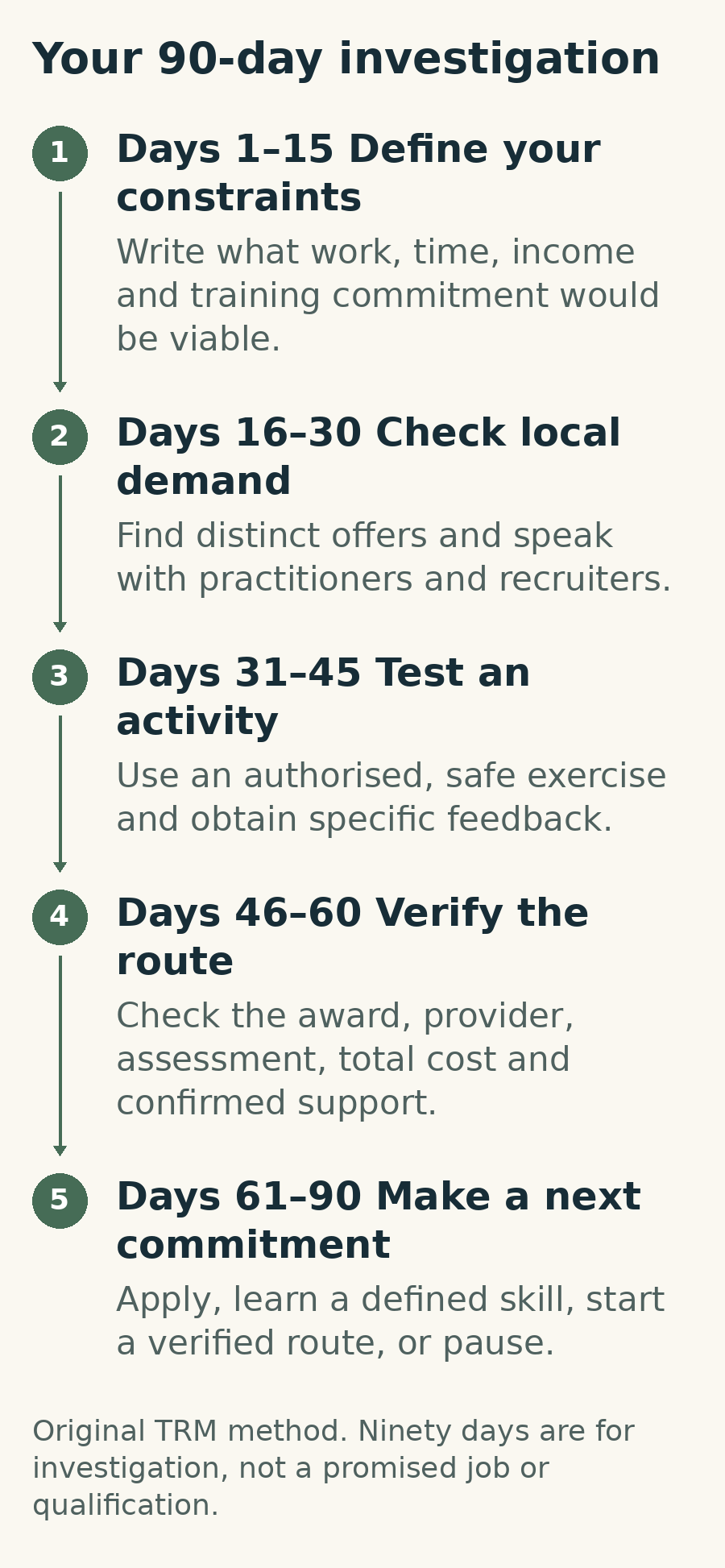
Original conceptual diagram. The 90-day investigation: define constraints, check local demand, test an activity, verify a training route and make the next commitment. This is an investigation, not a promised qualification.
A promising occupation on a map of 2030 may be a poor choice for you today. Start with a place, a set of constraints, existing skills and an employer or customer need. This 90-day investigation helps you decide what to pursue. It does not promise a job or a qualification in three months. Some routes require years of study; these three months help you decide whether that investment makes sense.
The suggested numbers of interviews and vacancies below are practical TRM method choices, not scientific thresholds or representative samples. Adapt them when hiring is sparse, access depends on competitive examinations or employers recruit through other channels. The public procedures and funding routes described here apply to France. They must not be presented as European entitlements.
Days 1–15: define what you need
Write one page covering four things: the work you want to do each day, what you already know how to do, what you can invest and what would be incompatible with your life. Specify your necessary income, commuting limit, working hours, geographical mobility, accessibility needs and acceptable training duration. Some information can remain private; a recruiter does not need your medical diagnosis or household budget.
List three concrete achievements. For each, describe the situation, your action, an observable result and something another person could confirm. Planning a delivery route, solving a fault, helping a service user or cleaning a spreadsheet can demonstrate transferable skills even when your previous job title sounds unrelated to your next occupation.
Choose two career options and a fallback. For each, identify tasks you want to do, tasks you can accept and tasks you refuse. “Working in AI” is too broad; “improving a customer service process while checking the system’s errors” gives you something to investigate.
In France, you can explore the conseil en évolution professionnelle (CEP), a free, personalised career development service. Your contact depends on your situation and where you live. It can help clarify a project and identify possible funding routes. Do not confuse this service with a paid bilan de compétences, a skills assessment. [P01]
Output: one page of constraints and two career hypotheses. Proceed when: you can explain how the options differ. Pause when: a decisive constraint remains unknown; resolve it before buying training.
Days 16–30: check local demand
Read around ten recent vacancies for each option, if that volume exists locally. Record the date, location, contract, actual duties, requirements and pay where disclosed. Remove duplicates and reposts: twenty advertisements need not mean twenty separate jobs. Add official occupation profiles and, where relevant, examination procedures or requirements for regulated professions.
Seek three conversations: someone doing the work, someone recruiting and someone who entered recently. Ask what fills an ordinary week, which mistakes are costly, what beginners are trusted to do, what digital tools are changing, why people leave and which evidence of competence earns an interview. One experience cannot describe a whole labour market. Record both agreement and disagreement.
Compare pay on consistent terms. Check gross or net, monthly or annual, full time or part time, fixed pay or bonuses, experience, on-call duties and location. A national average for managers is not an entry salary for a specific occupation. Insee full-time-equivalent data provide context; current local offers and applicable collective agreements help establish your own case. Do not convert a 2024 figure into a guaranteed salary for 2030. [P08]
Output: a dated local market note for each option. Proceed when: you can identify employers and a plausible entry route. Stop or switch when: accessible positions consistently require a condition you cannot meet.
Days 31–45: try the work before committing
Design a bounded exercise: diagnose a fictional fault, analyse a public dataset, explain a procedure, plan a route or repair a simple object with appropriate supervision. Choose a result a practitioner can examine. Use public, synthetic or authorised information. A career exercise does not justify accessing customer data or performing hazardous work.
Where appropriate in France, ask about a période de mise en situation en milieu professionnel (PMSMP), a formally arranged workplace immersion. It can help you discover an occupation, test a career plan or begin a recruitment process. It requires a prescribing organisation and an agreement; it is not permission to work unpaid without a framework. Confirm eligibility, status and any continuing income or benefits with your supporting organisation. [P02]
After the exercise, record your interest, fatigue, difficulties and feedback. Distinguish liking a sector from tolerating the ordinary duties of a particular job. An unsuccessful first attempt may reveal a learnable gap. A lasting incompatibility with the schedule or physical demands calls for a different response.
Output: a sample of work and external feedback. Proceed when: you understand a specific gap between your present ability and the expected level. Stop when: essential conditions remain unsuitable after considering reasonable adjustments.
What the French training labels mean
In France, RNCP records professional certifications validating knowledge and skills for professional activities, classified by qualification level and field. The Répertoire spécifique (RS) covers complementary professional skills and authorisations, such as safety authorisations or specialisation. These are different purposes, not interchangeable labels. [P10] Qualiopi concerns the quality of a provider’s processes under a common framework; it is not a personal guarantee of employment or earnings. [P11] Check the exact register entry, its validity, awarding body, assessment and the provider’s authorisation before enrolling. Registration of a certification should not be read as an endorsement of every course advertised using its name. [P04]
Days 46–60: investigate training and funding
Before signing, request the precise certification title, its RNCP or RS code when registration is claimed, the awarding body and the training provider. Check whether the register entry is valid, its prerequisites, competency blocks and whether the provider is authorised to prepare candidates. An appealing marketing label is no substitute. Use the distinctions above to examine what the actual certification establishes. [P03, P04]
Request the detailed syllabus, an example assessment, instructor qualifications and the amount of individual support. For a success or employment rate, ask for the period, cohort size, response rate and definition of employment related to the course. An impressive percentage may describe a small group. Find out who runs the examination, which charges remain and what happens if you leave the programme.
Treat an AI course promising a guaranteed occupation with scepticism. A demonstration is not evidence of professional competence. A course focused solely on an interface, without error checking, confidentiality or domain knowledge, may leave important gaps. Prefer learning tied to tasks you can demonstrate. To protect your French compte personnel de formation (CPF), your personal training account, use the official website and never give CPF or FranceConnect credentials to a third party. [P09]
Discuss possible routes with an appropriate adviser: apprenticeship, continuing education, CPF use, employer or other funding, projet de transition professionnelle (PTP), or validation des acquis de l’expérience (VAE). These names refer to French procedures. Apprenticeship is an employment contract combining workplace learning and formal instruction, subject to age rules and exceptions. PTP supports qualifying career-change training under conditions and a funding decision. VAE recognises relevant prior experience towards a certification accessible through that route; the assessment panel may award partial recognition or decline it. France VAE does not cover every certification or situation, and public servants use their usual contacts. None of these routes guarantees financial support for your case. [P05, P06, P07]
Build a monthly budget including tuition, examinations, equipment, travel, possible accommodation, childcare and lost income. Separate money available, support confirmed in writing and support merely hoped for. Include a delayed or refused funding scenario. Compare total out-of-pocket costs and time with another route, rather than comparing headline tuition alone.
Output: a funding table and a comparison of two learning routes. Proceed when: you meet entry requirements and the plan remains viable without hypothetical funding. Pause when: documents are missing, the seller presses for a decision or costs are incomplete.
Days 61–90: decide and secure a real next step
Return to your two options using the comparison below. Put an observation, its date and its source in every row. An uncertainty is not a zero score; it triggers an investigation. Do not let several attractive features compensate for an insurmountable legal entry requirement.
Access
Decisive question: Can I meet entry requirements?
Evidence to seek: Qualification entry, awarding body, examination or employer
Demand
Decisive question: Who hires at my level in my area?
Evidence to seek: Distinct vacancies and a recruitment conversation
Actual work
Decisive question: Do the duties and hours suit me?
Evidence to seek: Observation, immersion and practitioner feedback
Learning
Decisive question: Which gap must I close?
Evidence to seek: Assessed exercise and competency framework
Viability
Decisive question: Does the plan survive a delay or refused funding?
Evidence to seek: Monthly budget and written commitments
Development
Decisive question: What could I learn or transfer later?
Evidence to seek: Documented pathway and related tasks
Choose between four decisions: apply now, learn a specific competency block, enter a longer programme or set the option aside for now. Prepare a concise introduction covering what you can do, your work sample, the problem you want to solve and what you still need to learn. Set a review date and a concrete outcome to examine: a meeting secured, an application considered, admission to training or reasoned feedback on your exercise.
These 90 days can succeed by showing you which course not to buy. You will have reduced a costly uncertainty. If you continue, retain your evidence and check the market, training conditions and budget again before each major commitment.
Worksheets for a decision you can explain
These worksheets are original TRM investigation tools. The examples and suggested sample sizes are illustrative. They are not validated career tests and do not produce an employment probability. Copy the fields into your own document or notebook and complete them with dated evidence; a missing answer should trigger an enquiry rather than an arbitrary score.
Your career brief
Write the occupation and location you are investigating. Describe the ordinary activities you hope to do, not only the sector you admire. State your necessary income, commuting limit, workable schedule and maximum training commitment. Keep sensitive personal information in your private copy.
My first target and the work it involves
Your answer: ______________________________
My neighbouring option and the skills it shares
Your answer: ______________________________
Conditions I must verify before proceeding
Your answer: ______________________________
What I can spend and which funding is confirmed
Your answer: ______________________________
One uncertainty I will resolve this week
Your answer: ______________________________
A local vacancy record
For each distinct offer, record employer, source link, date, location, contract, working hours, duties, required qualification, experience and pay terms. Mark reposts and duplicates. Separate an essential requirement from an employer preference. Preserve the original wording when that distinction is uncertain.
Illustrative entry: a maintenance advert requires an appropriate technical qualification, rotating shifts and travel to a named site. Your transferable diagnostic skills may matter, but they do not establish qualification equivalence or make the shifts workable. Ask the employer what equivalent experience they consider, what supervision is available and how the rota operates.
A task and AI experiment
Choose a harmless task using public or fictional data. Define the result, acceptable errors and who can judge it. Record preparation, production, checking and correction time, with and without assistance. Include mistakes the tool introduced and useful suggestions you rejected.
Task and data permissions
Your answer: ______________________________
Quality criterion and unacceptable errors
Your answer: ______________________________
Time spent including checks and corrections
Your answer: ______________________________
What I learned and who reviewed it
Your answer: ______________________________
A single trial is a learning exercise, not an experiment establishing a general productivity effect. Repeat comparable tasks if that would improve your decision. Never turn a healthcare, security or electrical exercise into unsupervised professional practice.
Training comparison
Compare two specific routes using the same fields: official award, active register entry where relevant, prerequisites, provider authorisation, supervised practice, assessment, completion time, total cost and published outcomes with their denominators. Record who supplied each answer and when. Keep written terms before paying.
If a programme claims that 90% find work, ask: 90% of whom, after how long, in what kind of work, with how many non-respondents? That percentage is an illustrative example, not a claim about any provider. A provider who cannot explain the figure has not supplied enough evidence for your decision.
Budget and commitment
List tuition, examination, equipment, travel, accommodation and care costs by month. Add income lost during study. Put written funding commitments in one category and hoped-for support in another. Test whether the route is still viable with a delay or a refusal. Do not treat an expected future salary as cash available now.
Set a decision date and one of four outcomes: apply now, learn a specific skill, enter a longer verified route, or pause the target. Record the reason and the next evidence you need. Include a neighbouring option rather than accepting a sunk cost as a reason to continue indefinitely.
A portfolio entry
Use a short account of the problem, your personal contribution, tools and permissions, checks, result and limitations. Explain what you would do differently. Remove confidential information. Do not present generated work as evidence of competence you cannot demonstrate independently.
Illustrative example: using a public water dataset, you cleaned inconsistent units, described missing values and drew a clearly labelled chart. A practitioner checked your reasoning. The entry shows data handling and caution; it does not prove competence to certify drinking-water safety.
Questions for an employer
Ask what a beginner does in the first month, who supervises them, how mistakes are handled and which tasks need authorisation. Ask why the position is open and how long previous staff stayed. Request actual shift and travel arrangements. Where AI is used, ask who checks its outputs and what training is provided.
A six-month review note
Record what you expected, what happened and what has changed in your circumstances. Refresh distinct local vacancies, course conditions, costs and official evidence. Which assumption is still supported? Which one has weakened? What would justify changing your plan? Use the Oracle scenarios to challenge a long commitment, not to defend a prediction.
A fictional decision in practice
Alex is considering a data role and technical maintenance. This example is invented; no vacancies, interviews or outcomes are claimed. Alex needs predictable weekday hours and cannot finance full-time study without confirmed support. The data route initially looks attractive because work can sometimes be remote. Local enquiry has not yet established suitable junior vacancies, however, and a provider’s funding estimate is unconfirmed. Maintenance could use Alex’s existing diagnostic experience, but the proposed shift pattern conflicts with a care responsibility.
Alex therefore postpones both costly commitments. The next steps are to ask a data employer about supervised entry work, verify written funding conditions, and investigate a maintenance employer with a different rota. Neither a sector growth projection nor an attractive course brochure resolves these constraints. If the evidence remains weak, choosing a neighbouring route or keeping the current position can be a reasoned result of the investigation.
Method and updates
This guide combines primary institutional publications, official occupation and training information, and empirical research. Experiments, exposure indices, administrative studies and employer-intention surveys are kept separate. Preprints are identified in the research dossier and are interpreted with their limits. The occupational task analysis, scenarios, worksheets and 90-day plan are original editorial work, not official endorsements.
The first review checked claims, geography, study versions and professional entry information. A second review challenged the complete manuscript; a further pass checked the corrections. The Wix presentation and illustrations are checked separately from the manuscript review. These were AI-assisted editorial reviews; the guide does not claim outside professional accreditation.
Original symbolic illustrations were generated for this guide. They depict imagined situations and contain no documentary testimony. Conceptual diagrams were drawn from the guide’s explanations and are labelled as conceptual. No third-party photographs, charts or logos are reproduced. Provenance, prompts, review records and sources are included in the production dossier.
Before relying on an entry route, check the current award, admission and professional requirements with the competent institution. Before a later edition or commercial release, recheck core datasets, study revisions, training information and publication terms. Record each correction by date, affected section, old statement, replacement and reason. A suggested six-month editorial review is a maintenance proposal, not an automatic subscription or scheduled service.
For future commercial use, verify the rights and sales terms separately. Generated illustrations should not be represented as exclusive copyrighted human artwork; original editorial contribution and the applicable service terms matter. This guide does not offer a paid product or promise an individual career outcome.
Source directory
References were checked for this edition on 4 October 2026. Dates below are publication or update dates where available; the observation period may be earlier. French official qualification titles are retained. Follow the link for current conditions rather than relying on a downloaded guide when enrolling. Source access limitations are recorded in the production dossier.
[EMP01] France Stratégie et Dares. Les Métiers en 2030 — résumé (2022-03-10).
[EMP02] France Stratégie et Dares. Métiers 2030. Rapport du groupe Prospective des métiers et qualifications (2022-03-10).
[EMP04] France Travail. Besoins en Main-d’Œuvre 2026 — publication nationale (2026-04-21).
[EMP06] Cedefop. Cedefop updates Skills Forecast: new data to guide Europe’s skills and labour market policy to 2035 (2026-07-21).
[EMP07] France Stratégie et Dares. Les métiers en 2030 : quelles perspectives de recrutement en région ? (2023-01-24).
[IA01] Gmyrek et al., OIT–NASK. Generative AI and Jobs: A Refined Global Index of Occupational Exposure (2025-05-20).
[IA02] Brynjolfsson, Li, Raymond. Generative AI at Work (2025-05).
[IA03] Noy, Zhang. Experimental evidence on the productivity effects of generative artificial intelligence (2023-07-14).
[IA04] Becker, Rush, Barnes, Rein. Measuring the Impact of Early-2025 AI on Experienced Open-Source Developer Productivity (2025-07-25).
[IA05] Dillon, Jaffe, Immorlica, Stanton. Shifting Work Patterns with Generative AI (2025-11-13).
[IA06] Humlum, Vestergaard. Still Waters, Rapid Currents: Early Labor Market Transformation under Generative AI (2026-03-13).
[IA07] Brynjolfsson, Chandar, Chen. Canaries in the Coal Mine? Six Facts about the Recent Employment Effects of Artificial Intelligence (2026-08-12).
[IA08] Golo Henseke. From Exposure to Adoption: Generative AI in European Workplaces (2026-04-28).
[IA09] Becker, Rush, Cunningham, Rein, Mahamud / METR. We are Changing our Developer Productivity Experiment Design (2026-02-24).
[OR01] Cedefop. Cedefop updates Skills Forecast: new data to guide Europe's skills and labour market policy to 2035 (2026-07-21).
[OR02] Eurostat. 20% of EU enterprises use AI technologies (2025-12-11).
[OR03] IEA. World Energy Employment 2025 — Executive summary (2025-12-05).
[OR04] European Commission DG ECFIN. 2024 Ageing Report. Economic and Budgetary Projections for the EU Member States (2022-2070) (2024-04-18).
[OR05] French Ministry for Ecological Transition. Le gouvernement lance un nouveau plan national d’adaptation au changement climatique (2025-03-10).
[OR06] European Investment Bank. Investment Report 2025/26 — Executive Summary (2026-03-03).
[F01] Onisep. Diplôme d'État d'infirmier. Date not displayed.
[F02] Onisep. Aide-soignant / Aide-soignante. Date not displayed.
[F03] Onisep. Diplôme d'État d'aide-soignant. Date not displayed.
[F04] Onisep. Diplôme d'État d'accompagnant éducatif et social. Date not displayed.
[F05] Onisep. Diplôme d'État d'éducateur spécialisé. Date not displayed.
[F06] Onisep. Technicien / Technicienne de maintenance industrielle. Date not displayed.
[F07] Onisep. Électricien installateur / Électricienne installatrice. Date not displayed.
[F08] Onisep. Technicien / Technicienne de maintenance en génie climatique. Date not displayed.
[F09] Onisep. Technicien / Technicienne d'exploitation de l'eau. Date not displayed.
[F10] Onisep. Dépanneur / Dépanneuse en électroménager. Date not displayed.
[F11] Onisep. Technicien / Technicienne de mesure de la pollution. Date not displayed.
[F12] Onisep. Analyste SOC. Date not displayed.
[F13] Onisep. Data analyst (analyste de données). Date not displayed.
[F14] Choisir le service public. Data engineer. Date not displayed.
[F15] France compétences. RNCP42655 — Data engineer (registration decision 2026-07-17).
[F16] Onisep. Chef / Cheffe de projet informatique. Date not displayed.
[F17] Onisep. Formateur / Formatrice d'adultes. Date not displayed.
[F18] France compétences. RNCP37275 — TP - Formateur professionnel d'adultes (2023-01-25).
[F19] Onisep. Concepteur pédagogique multimodal / Conceptrice pédagogique multimodale. Date not displayed.
[F20] Onisep. Technicien / Technicienne qualité. Date not displayed.
[F21] Onisep. Technicien / Technicienne logistique. Date not displayed.
[F22] Onisep. Comptable. Date not displayed.
[F23] Onisep. Commercial / Commerciale sédentaire. Date not displayed.
[F24] Onisep. Commercial itinérant / Commerciale itinérante. Date not displayed.
[F25] Onisep. Les titres enregistrés au RNCP (2026-04-23).
[P01] Service Public / DILA. Conseil en évolution professionnelle (CEP) (2026-02-20).
[P02] Service Public / DILA. Qu'est-ce qu'une période de mise en situation en milieu professionnel (PMSMP) ? (2026-03-20).
[P03] France compétences. Résultats de recherche — certification registers. Date not displayed.
[P04] Caisse des Dépôts / Mon Compte Formation. Qu'est-ce qu'une habilitation à former ?. Date not displayed.
[P05] Service Public / DILA and Ministry of Labour. Contrat d'apprentissage (2026-09-08).
[P06] Service Public / DILA. Projet de transition professionnelle (PTP) (2026-06-01).
[P07] Service Public / DILA. Validation des acquis de l'expérience (VAE) (2026-08-13).
[P08] Insee. L'essentiel sur… les salaires (2026-01-19).
[P09] Caisse des Dépôts / Mon Compte Formation. Attention — Arnaques CPF — Soyez vigilant !. Date not displayed.
[P10] France compétences. Certification : le rôle de France compétences. Date not displayed.
[P11] France compétences. Qualité de la formation. Date not displayed.



Comments